
Professor of Biology
Office 3352 Spieth Hall
Phone (951) 827-2437
E-mail: derek.roff@ucr.edu
Degree and Professional Awards:
Ph. D., University of British Columbia
Fellow of the Royal Society of Canada
Fellow of the America Association for the Advancement of Science
Professor Emeritus. McGill University
Dr. Roff is an evolutionary population ecologist with wide-ranging interests in population and quantitative genetics, life-history, and the importance of trade-offs in shaping life history evolution. His work is both theoretical and empirical, and he has studied organisms ranging from seals, birds and fish to fruit flies and planktonic crustaceans. Much of his current research focuses on insects as model systems.
|
In many organisms females (or males) are able to exercise choice among potential mates. Such circumstances are expected to give rise to the joint evolution of female preference and the preferred male trait. Several disparate theories predict the coevolution of female (or male) preferences and the preferred male (female) trait(s) but they all have in common the prediction that a genetic correlation will be built up between the preferred trait and the preference. The general consensus is that such a correlation will be the result of linkage disequilibrium (a statistical association of the preference genes with the genes of the preferred trait) rather than pleiotropy (a correlation generated by genes that affect both traits. The question of whether a genetic correlation exists and the mechanism generating it can only be decided empirically. Because this genetic correlation is a cornerstone of the major theories for the evolution of female preference, experimental demonstration of its existence and analysis of its causal mechanisms are of central importance and is one of the most intensely studied subjects in behavioral ecology. |
In many organisms females (or males) are able to exercise choice among potential mates. Such circumstances are expected to give rise to the joint evolution of female preference and the preferred male trait. Several disparate theories predict the coevolution of female (or male) preferences and the preferred male (female) trait(s) but they all have in common the prediction that a genetic correlation will be built up between the preferred trait and the preference. The general consensus is that such a correlation will be the result of linkage disequilibrium (a statistical association of the preference genes with the genes of the preferred trait) rather than pleiotropy (a correlation generated by genes that affect both traits. The question of whether a genetic correlation exists and the mechanism generating it can only be decided empirically. Because this genetic correlation is a cornerstone of the major theories for the evolution of female preference, experimental demonstration of its existence and analysis of its causal mechanisms are of central importance and is one of the most intensely studied subjects in behavioral ecology.
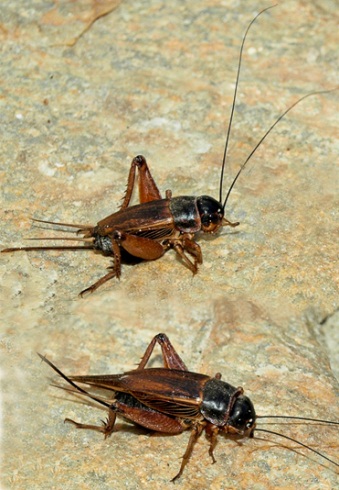
My present research concerns the experimental examination of the evolution of female preference and the preferred male traits. For this I am using the sand cricket. Previous work in my lab has shown that females prefer particular types of males and that this preference is geographically variable. We are furthering this investigation by determining in greater detail which song components are most preferred, the genetic basis of both preference and the preferred traits, and the genetic basis of the correlation between them.
Dr. Roff came to us from a faculty position at McGill University, Canada. He
began his work at UCR in July 2001 and participates in IDEA, the UCR Institute for the Development of Educational Applications.
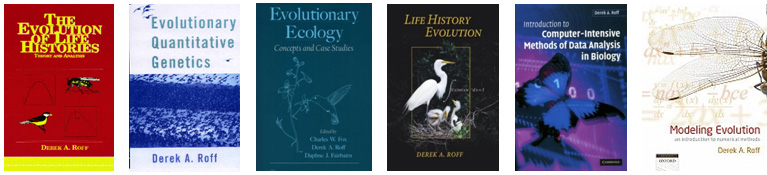
Click here for a complete publication list.
Click here to download Appendix C for Introduction to Computer-Intensive Methods of Data Analysis in Biology.
Click here to download R and MATLAB codes used in Modeling Evolution (corrected 1-28-2010).