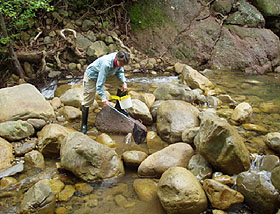
 Dr. Fairbairn is an evolutionary biologist with wide-ranging expertise in quantitative genetics, life history theory, and natural and sexual selection. Her work is based strongly on empirical studies supported by a robust theoretical component.
Emeritus Professor of Biology
Office 3310 Spieth Hall
Phone (951) 827-4791
E-mail: daphne.fairbairn@ucr.edu
Degree:
Ph.D., University of British Columbia
Dr. Fairbairn is an evolutionary biologist with wide-ranging expertise in quantitative genetics, life history theory, and natural and sexual selection. Her work is based strongly on empirical studies supported by a robust theoretical component.
Dr. Fairbairn's work seeks to predict and measure the influence of natural and sexual selection on contemporary trait distributions, and to determine the extent to which adaptation is constrained by lack of genetic variation and strong genetic correlations among traits. For this research, she studies traits that show dimorphic variation in which a common genome produces two distinct phenotypes. Her two primary areas of focus are sexual dimorphisms in animals (i.e., differences between males and females) and migratory dimorphisms in insects. The latter include dimorphic variation within species in wing morphology, flight muscle development and behavioral responses.
She has worked with many different organisms including insects, spiders, mice and fish. Much of her recent research particularly on sexual dimorphisms has focused on a group of semiaquatic insects, the water striders (Hemiptera, Gerridae). Water striders have a complex and varied life history, with considerable diversity within and between species in size, morphology, dispersal patterns, and mating behaviors. They offer an exceptionally good model system for testing evolutionary models because populations can be monitored and experimentally manipulated in the wild and can also be readily be maintained and observed in laboratory.
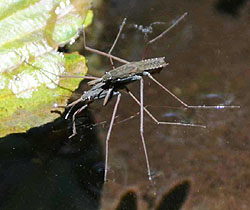 Dr. Fairbairn’s interest in sexual dimorphisms has led to intensive studies of mating behavior and of conflicts of interest between the sexes, both of which may exert strong, divergent selection on body morphology, life history and behavior in males and females. This research extends into behavioral ecology, life history theory, quantitative genetics, reproductive physiology, adaptive genital morphology and sperm competition. Her most recent studies have focused on the quantitative genetic architecture of sexually dimorphic traits.
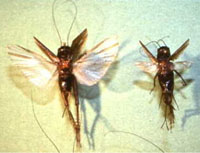 Her studies of migratory dimorphisms in insects combine artificial selection, experimental evolution, quantitative genetics, life history theory, behavioral ecology and physiology. She uses water striders for the field aspects of this research, and the cricket, Gryllus firmus for intensive laboratory experiments. The experimental work on crickets is done in collaboration with Dr. Derek Roff.
Dr. Fairbairn participates in IDEA, the UCR Institute for the Development of Educational Applications.
Selected publications...
Books:
 Fox, C. W., Roff, D. A. and D. J. Fairbairn. 2001. (eds.) Evolutionary Ecology. Concepts and Case Studies. Oxford University Press, New York. link
Click here for a description of this book.
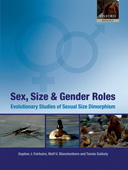 Fairbairn, D. J., Blanckenhorn, W. U. and T. Székely. 2007 (eds.) Sex, Size and Gender Roles. Evolutionary Studies of Sexual Size Dimorphism. Oxford University Press. link
Click here for a description of Sex, Size and Gender Roles.
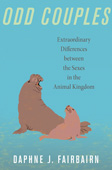 Fairbairn, D. J. 2013. Odd Couples. Extraordinary Differences between the Sexes in the Animal Kingdom. Princeton University Press, Princeton and Oxford. link
Click here for a description of Odd Couples.
Journal articles:
Fairbairn, D. J. 1997. Allometry for sexual size dimorphism: Pattern and process in the coevolution of body size in males and females. Annual Review of Ecology and Systematics 28: 659-687.
Preziosi, R. F. and D. J. Fairbairn. 2000. Lifetime selection on adult body size and components of body size in a waterstrider: opposing selection and maintenance of sexual size dimorphism. Evolution 54: 558-566.
Reeve, J. P. and D. J. Fairbairn. 2001. Predicting the evolution of sexual size dimorphism. Journal of Evolutionary Biology 14: 244-254. doi: 10.1046/j.1420-9101.2001.00276.x
Fairbairn, D. J., Vermette, R., Kapoor, N. N. and N. Zahiri. 2003. Functional significance of sexually selected genitalia in the water strider, Aquarius remigis. Canadian Journal of Zoology 81: 400-413.
Fairbairn, D. J. 2005. Allometry for sexual size dimorphism: Testing two hypotheses for Rensch’s rule in the water strider, Aquarius remigis. American Naturalist 166: S69-S84. DOI: 10.1086/444600
Bertin, A. and D. J. Fairbairn. 2007. The form of sexual selection on male genitalia cannot be inferred from within-population variance and allometry. A case study in Aquarius remigis. Evolution 61: 825-837.
Roff, D. A. and D. J. Fairbairn. 2007. The evolution of trade-offs: where are we? Journal of Evolutionary Biology 20:433-447.
Roff, D. A. and D. J. Fairbairn. 2007. Laboratory evolution of the migratory polymorphism in the sand cricket: combining physiology and quantitative genetics. Physiological and Biochemical Zoology 80: 358–369
Fairbairn, D. J. and E. King. 2009. Why do Californian striders fly? Journal of Evolutionary Biology 22: 36–49. doi:10.1111/j.1420-9101.2008.01619.x
Roff, D. A. and D. J. Fairbairn. 2011. Path analysis of the genetic integration of traits in the sand cricket: a novel use of BLUPS. Journal of Evolutionary Biology 24: 1857–1869, DOI: 10.1111/j.1420-9101.2011.02315.x
Wolak, M. E., Fairbairn, D. J. and Y. R. Paulsen. 2012. Guidelines for estimating repeatability. Methods in Ecology and Evolution 3: 129–137. DOI: 10.1111/j.2041-210X.2011.00125.x
Roff, D. A. and D. J. Fairbairn, 2012. The evolution of trade-offs under directional and correlational selection. Evolution 66:2461-2474. DOI: 10.1111/j.1558-5646.2012.01634.x
Roff , D. A. and D. J. Fairbairn, 2012. A test of the hypothesis that correlational selection generates genetic correlations. Evolution 66: 2953-2969. DOI: 10.1111/j.1558-5646.2012.01656.x
Roff, D. A. and D. J. Fairbairn. 2014. The Evolution of Phenotypes and Genetic Parameters under Preferential Mating. Ecology and Evolution, 4:2759-76. http://onlinelibrary.wiley.com/doi/10.1002/ece3.1130/full
Wolak, M. E., Roff, D. A. and Fairbairn, D. J. 2015. Are we underestimating the genetic variances of dimorphic traits? Ecology and Evolution 5(3): 590-597. doi: 10.1002/ece3.1361
Roff, D. A. and D. J. Fairbairn. 2015. Bias in the heritability of preference and its potential impact on the evolution of mate choice. Heredity 114: 404-412 doi:10.1038/hdy.2014.117.
Fairbairn, D. J., Kiseliova, O. and Muir, S. 2016. Variation in chromosome numbers and the sex determination system in the Gerromorpha with special reference to the family Gerridae. Aquatic Insects published online May 16, 2016. http://dx.doi.org/10.1080/01650424.2016.1167222
Click here to
see a complete publication
list.
Click here for an abbreviated CV.